

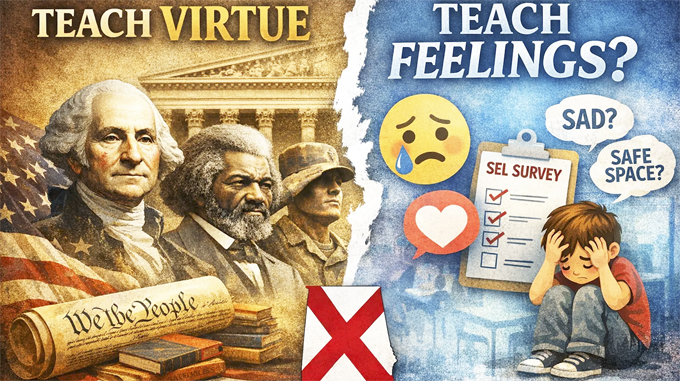
Across Alabama, school districts are increasingly adopting “character education” programs meant to promote respect, responsibility, and good behavior. These programs are often referred to as SEL (social-emotional learning).
The intent is understandable. Order matters. Civility matters. But behavior is not the same as moral formation.
For most of American history, education aimed higher than behavior management. From Aristotle to the American Founders, education was understood to include the cultivation of virtue – the habits of judgment and self-control that allow free people to govern themselves. Virtue education asks not simply how students act, but who they are becoming.
That distinction matters in public schools. Alabama’s social studies course of study emphasizes civic responsibility, ethical reasoning, and informed citizenship. Those goals cannot be met through compliance alone. Students must learn how to reason about right and wrong, not merely how to follow rules.
Modern character programs typically focus on observable conduct: following directions, displaying approved traits, and avoiding disruption. These tools may help maintain order, but they remain shallow. A student can behave well without understanding why. He can comply without conviction. He can follow rules only when someone is watching.
Virtue, by contrast, is internal and lasting. It is formed through practice, reflection, and the study of moral examples. Prudence teaches students to choose wisely. Courage teaches them to do what is right even when it is hard. Justice teaches fairness. Temperance teaches self-control. Integrity unites belief and action. These are not abstract concepts; they are the traits required for responsible citizenship.
The American Founders understood this. John Adams warned that the Constitution was designed only for a moral people. George Washington argued that virtue was essential to liberty. They were not calling for ideology or therapy. They were describing self-government rooted in moral habit.
Properly understood, virtue education respects legal and parental boundaries. It does not involve counseling or mental-health services. It does not impose political viewpoints or ideology. It does not interfere with parental rights. Instead, it relies on historical exemplars already embedded in Alabama’s academic standards and reinforces the constitutional principles on which this state and nation were founded.
Alabama students already study figures such as Abraham Lincoln, Benjamin Franklin, Frederick Douglass, and George Washington Carver. Teaching the virtues these individuals embodied is not a departure from public education. It is a return to it.
When moral instruction is reduced to slogans, posters, or behavior charts, students may learn how to avoid consequences – but not how to exercise judgment. A free society cannot survive on rules alone. It depends on citizens capable of restraint, responsibility, and moral reasoning.
Character may regulate behavior. Virtue forms citizens!