



SPEAKIN’ OUT NEWS
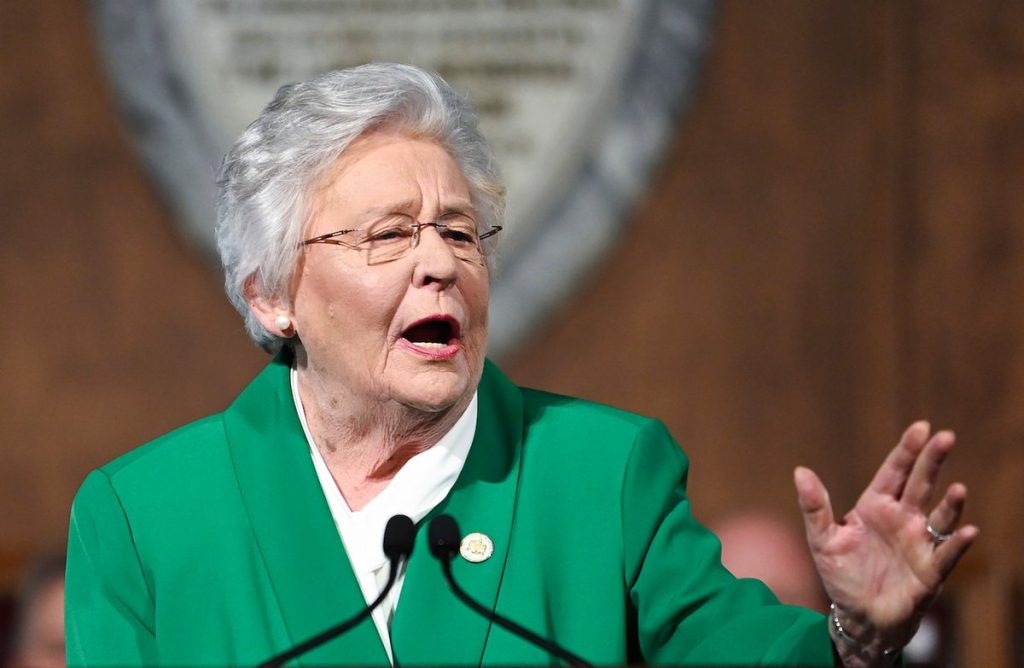
MONTGOMERY — Gov. Kay Ivey said Friday she will not call a special legislative session to redraw Alabama’s state Senate map, despite a federal court ruling that the Montgomery portion of the map violates the Voting Rights Act.
In August, U.S. District Judge Anna M. Manasco, a Trump appointee, ruled that the state’s current map dilutes Black voting power in Montgomery by giving them less opportunity to elect candidates of their choice. The judge ordered lawmakers to create a second Senate district in Montgomery that is majority Black or close to majority Black.
Manasco’s ruling blocked the state from using the current map in next year’s elections and gave the Legislature the first chance to fix the violation. All 140 legislative seats, including 35 in the Senate, are on the ballot in 2026, with primaries set for May 19.
Ivey Calls for Clarity from Supreme Court
In a press release, Ivey said federal and constitutional requirements have left states in a “no-win situation.”
“As the law currently stands, states like Alabama are put to the virtually impossible task of protecting some voters based on race without discriminating against any other voters based on race,” Ivey said.
She added:
“I remain hopeful that we will somehow find the ‘magic map’ that will both satisfy the federal court and also be fair to all Alabamians. But as of today, I cannot justify the time and expense of calling a special session.”
Ivey said she might reconsider if a “satisfactory map” is later identified. She also called on the U.S. Supreme Court to clarify the law.
What Does Gov. Ivey Mean by a “Magic Map”?
When Gov. Ivey said Alabama cannot find a “magic map,” she was referring to the difficulty of complying with both Section 2 of the Voting Rights Act (VRA) and the U.S. Constitution’s ban on racial gerrymandering.
• Section 2 of the VRA requires that minority voters have a fair chance to elect candidates of their choice, often by creating majority-Black districts where population numbers justify it.
• At the same time, the Constitution prohibits drawing districts based mainly on race.
State officials argue this creates a legal catch-22: follow one rule and risk violating the other.
Judge Manasco ruled the Senate map fails Section 2 because Black voters in Montgomery lack equal opportunity compared to others. She ordered a second majority-Black or near-majority-Black district.
The debate recalls Alabama’s 2023 congressional redistricting battle, when the Legislature resisted court orders and a special master ultimately drew a second majority-Black district. That map led to the election of Shomari Figures as Alabama’s second Black member of Congress.
The Supreme Court’s upcoming decision in a Louisiana redistricting case could provide new clarity, with ripple effects for Alabama.
The Lawsuit and Appeal
The case was filed by the ACLU, ACLU of Alabama, the Legal Defense Fund, and the Southern Poverty Law Center. They argued the current plan unfairly packs Black voters into Senate District 26, represented by Sen. Kirk Hatcher (D-Montgomery), leaving surrounding District 25, represented by Sen. Will Barfoot (R-Montgomery), majority white and Republican.
Judge Manasco agreed with the plaintiffs on Montgomery but rejected claims that Huntsville’s Senate districts also violated the Voting Rights Act. Her ruling followed an eight-day trial that included testimony from 20 witnesses and arguments from 48 attorneys.
Secretary of State Wes Allen, the defendant in the case, has pledged to appeal the ruling. He will also ask the court to delay enforcement until the Supreme Court rules on a Louisiana redistricting case, scheduled for argument on Oct. 15, that could affect Alabama and other states.
What Happens Next
If the Legislature does not act, the court may appoint the same special master who redrew Alabama’s congressional map in 2023. That case, which also involved Section 2 of the Voting Rights Act, resulted in a court-drawn map that created a second majority-Black district and led to the election of Shomari Figures of Mobile as the state’s second Black member of Congress.
Earlier this week, Judge Manasco proposed that the special master begin working on a remedial Senate plan for Montgomery by Oct. 1. She has scheduled a conference call with attorneys for Monday.
Adding a second Black Senate district in Montgomery is not expected to change overall control of the chamber, where Republicans currently hold 27 of 35 seats.