


by SPEAKIN’ OUT NEWS

(City of Huntsville)


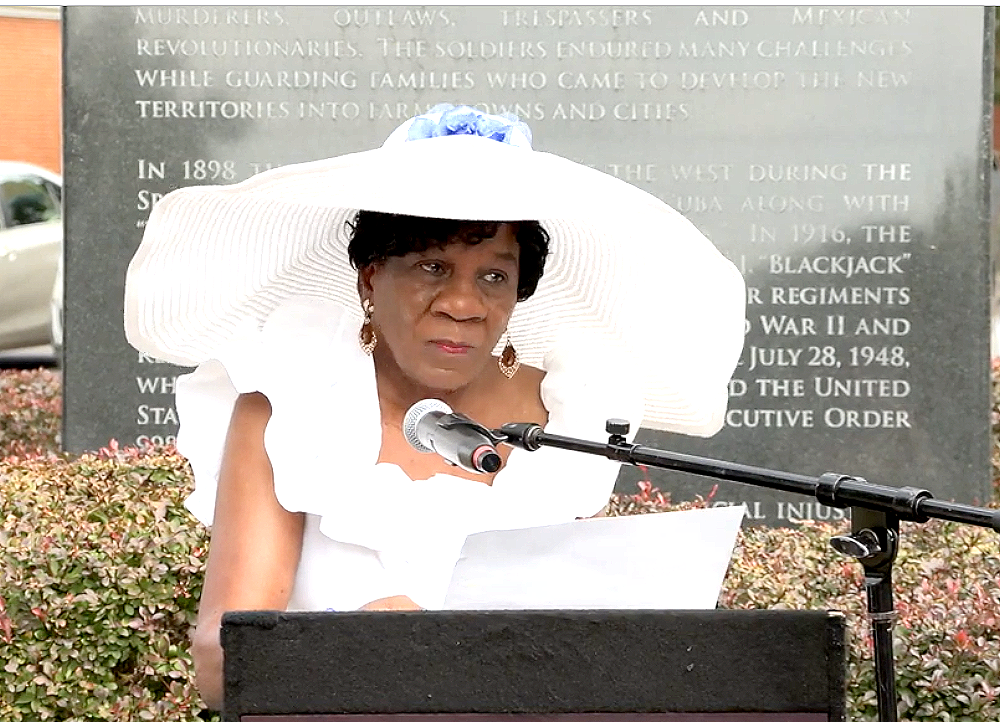
Left to right: Veronica Henderson, Library Director for the J.F. Drake State Memorial Learning Resources Center, and the State Black Archives at Alabama A&M University and Buffalo Soldier re-enactor, William Hampton. (City of Huntsville)


Left to right: Buffalo Soldier re-enactors Dr. John Humphrey as Soldier Pascal Conley; and Peggy Allen Towns, as Soldier Catherine Williams (City of Huntsville)
HUNTSVILLE, Ala. — The City of Huntsville commemorated National Buffalo Soldiers Day with a solemn and celebratory ceremony on Monday, July 28, at the 10th Cavalry Buffalo Soldier Memorial Monument on Poplar Avenue. The event honored the legacy of the first all-Black regiments in the U.S. Army and their historical ties to Cavalry Hill, where members of the 10th Cavalry Regiment were stationed from 1898 to 1899 following their service in the Spanish-American War.
Mayor Tommy Battle opened the program by recognizing several distinguished guests and community leaders, including Madison County Commissioner Violet Edwards, District 6, and State Representative Laura Hall, affectionately referred to as “The Tireless” for her years of dedicated public service. He also honored Ollye Ballard Conley for her advocacy, leadership, and unwavering commitment to preserving and commemorating this important piece of Huntsville’s history.
“This monument stands as a tribute,” Battle said, “not only to the 10th Cavalry Regiment but to the resilience, courage, and legacy of all Black service members.”
Huntsville’s Buffalo Soldiers Memorial is one of only three in the United States—and the only one east of the Mississippi River—the memorial’s bronze statue of Sgt. George Berry, who carried the regimental flag during the charge up San Juan Hill, stands as a powerful reminder of the bravery and sacrifice of Black soldiers throughout American history.
Dr. Randy Barbour, Director of the City’s Office of Multicultural Affairs, reminded attendees that the commemoration was about more than honoring history. “Honoring the Buffalo Soldiers is about more than remembering their time here,” he said. “It’s about recognizing their strength, resilience, and sacrifice in the face of injustice.”
The ceremony featured remarks from District 1 Council Member Michelle Watkins and the Library Director for the J.F. Drake State Memorial Learning Resources Center and the State Black Archives at Alabama A&M University. Alabama A&M University’s Veronica Henderson. A presentation of colors was carried out by Lee High School’s JROTC, followed by a poignant “Say Their Names” tribute from Lee High School Performing Arts Magnet student Alicia Toney, who recited the names of soldiers from the 10th Cavalry.
Buffalo Soldier re-enactors William Hampton, Peggy Towns, Dr. John Humphrey and Ashley Humphrey brought history to life through a live dialogue performance. Willie Smith and Jewell Cheatham participated in a ceremonial wreath laying, and local vocalist Reneda Kelley moved the crowd with her rendition of “Amazing Grace.” The program concluded with a benediction by Rev. Ophelia Davis.
“It is our duty to keep their stories alive—not just in books or museums, but in our hearts, our conversations and our classrooms,” said Council Member Watkins. “When we speak their names and teach their sacrifices, we ensure they are never forgotten.”
Historic Ties to Huntsville
The Buffalo Soldiers—African American regiments established by the Army Reorganization Act of 1866—played a critical role in U.S. military history, serving during the Indian Wars, the Spanish-American War and the Philippine-American War.
Among those units, the 10th U.S. Cavalry arrived in Huntsville in October 1898, convalescing from disease and harsh tropical conditions following their deployment in Cuba. First stationed at Camp Albert G. Forse atop Monte Sano, they later relocated to what became known as Cavalry Hill.
The U.S. Surgeon General had selected Huntsville for its reputation as one of the cleanest cities in the country. Despite being welcomed by many residents, the soldiers faced significant adversity. Their uniforms were worn, tents leaked, and they were stripped of their weapons due to racial tensions. Some soldiers even wrote to President William McKinley pleading for the return of their arms out of concern for their safety.
Yet, the soldiers’ bravery earned them admiration. One white soldier was quoted as saying, “We would not have won this war had it not been for the bravery of the 10th and 9th Cavalry soldiers.”
Remembering Their Names
Although many Buffalo Soldiers remain unnamed in the historical record, several have been identified and are now honored publicly:
• Sgt. George Berry, Troop G – Featured in the statue, Berry carried the flag at San Juan Hill.
• Sgt. Horace Wayman Bivins – A Silver Star recipient and the Army’s first double Distinguished Shooter.
• Charles B. Turner, Troop E – Rose from private to commissioned officer.
• 2nd Lt. Paschal Conley – Madison County native, literacy advocate, and posthumously promoted in 2012.
Other Medal of Honor recipients associated with the legacy of the 10th Cavalry include Augustus Walley, Henry Johnson, Fitz Lee, Edward L. Baker Jr., Dennis Bell, William Thompkins, and George Wanton.
A Living Monument
The idea for a Buffalo Soldiers memorial in Huntsville originated in the 1990s with civil rights leader Dr. John L. Cashin Jr. The statue of Sgt. Berry, sculpted by Casey Downing of Mobile in 2001, was originally housed inside the Academy for Academics and Arts—formerly Cavalry Hill School—before being moved outside in 2010 to its current pedestal.
Dedicated on April 30, 2010, the monument stands on a 10-foot granite base engraved with the names and history of the Buffalo Soldiers. Its creation was made possible through grassroots fundraising, a “Buy A Brick” campaign, and municipal support.
Today, the site remains a space for reflection and education. It draws school groups, veterans, and visitors year-round, particularly during Black History Month and Veterans Day. In 2024, new directional signage was added along Pulaski Pike to improve accessibility to the monument.
As the city paused once again to honor these brave soldiers, the message of the ceremony was clear: the legacy of the Buffalo Soldiers is not just Black history—it is American history.